CATEGORY 01
Herbal Oil Massages
जड़ी-बूटी युक्त तेल
Oils prepared with herbs such as bhringraj, amla, brahmi, shikakai, castor, rosemary, curry leaf, jatamansi, sesame, almond, fenugreek, triphala and neem — with how to prepare and apply each.
बालों की बेहतर देखभाल के लिए आसान घरेलू और आयुर्वेदिक तरीके
एक व्यावहारिक आयुर्वेदिक गाइड
This guide brings together 50 practical home and Ayurvedic approaches to hair care — herbal oil massages, hair masks and packs, herbal rinses, dietary habits and everyday Ayurvedic practices. Each one is written in simple Hindi with its ingredients, method, how to use it, and the benefits traditionally associated with it.
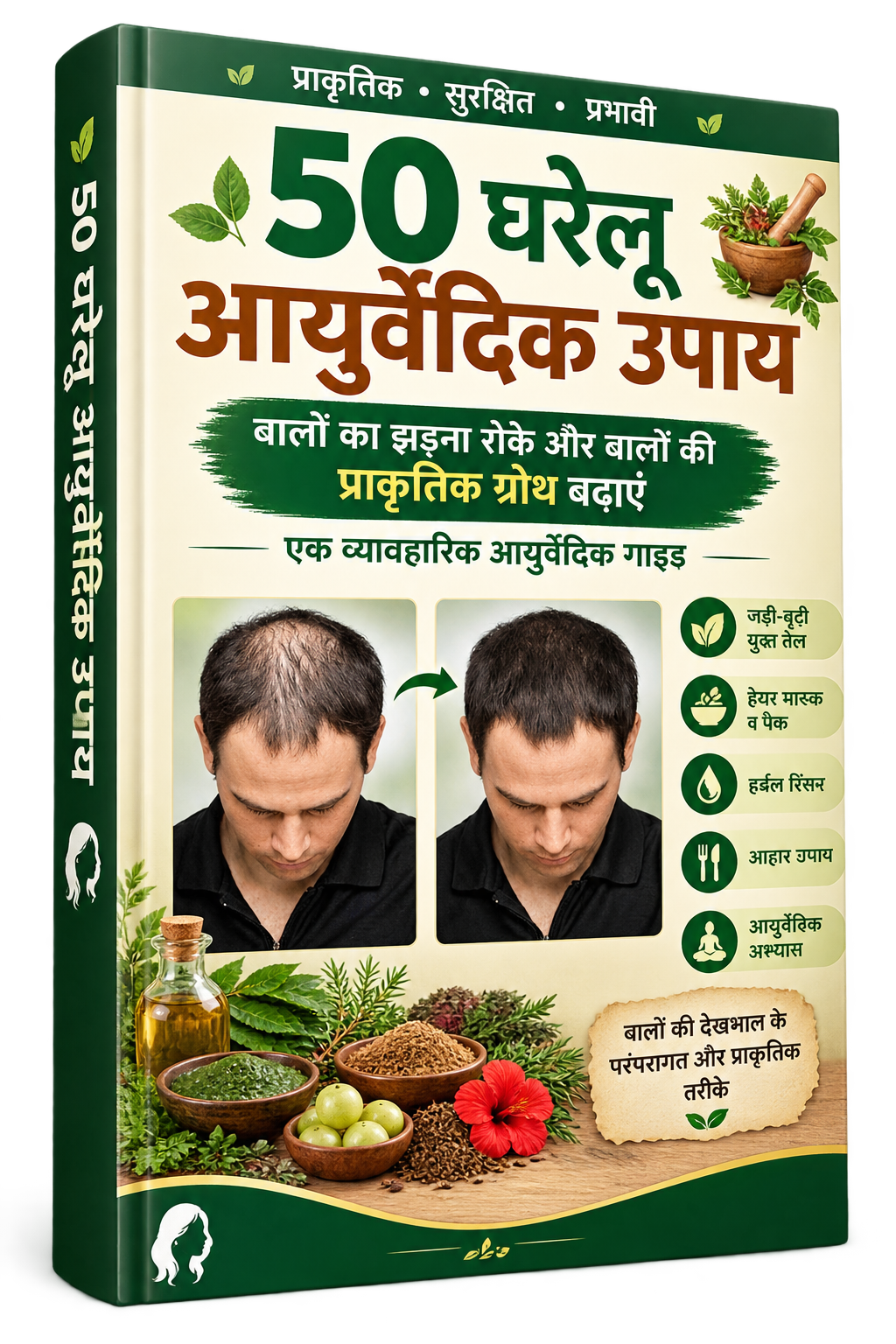
Digital product mockup. The eBook is delivered as a downloadable file.
Hair fall can have many possible causes, from nutrition and stress to hormonal and genetic factors. The eBook opens by walking through the reasons it most commonly lists, so you can think about your own routine with a clearer head instead of guessing.
This page is not a diagnosis. If your hair fall is heavy or getting worse, the eBook itself advises seeing a dermatologist or a qualified Ayurvedic practitioner rather than relying on home remedies alone.
The 50 approaches are organised into five categories, so you can start where it suits your routine. Alongside them, the guide covers the common causes of hair fall and a set of general hair-care suggestions.
CATEGORY 01
जड़ी-बूटी युक्त तेल
Oils prepared with herbs such as bhringraj, amla, brahmi, shikakai, castor, rosemary, curry leaf, jatamansi, sesame, almond, fenugreek, triphala and neem — with how to prepare and apply each.
CATEGORY 02
हेयर मास्क व पैक
Masks built from everyday kitchen and garden ingredients — fenugreek and curd, amla-reetha-shikakai, hibiscus and aloe vera, onion juice, henna, egg and olive oil, flaxseed gel, banana and honey, avocado, mulethi and more.
CATEGORY 03
हर्बल रिंस
Post-shampoo rinses using green tea, neem and tulsi, apple cider vinegar, rice water, hibiscus, black tea, fenugreek water and curry leaf water — each with the quantity and contact time.
CATEGORY 04
आंतरिक / आहार उपाय
What goes on the plate and in the glass: amla juice, triphala powder, ashwagandha with milk, fenugreek water, a balanced protein-rich diet, and adequate water and hydration.
CATEGORY 05
आयुर्वेदिक अभ्यास
Daily habits rather than ingredients: shiro abhyanga (scalp massage), pranayama and yoga, regular sleep and stress management, and sensible combing and handling of hair.
ALSO INCLUDED
A section on the common causes of hair fall, a list of general hair-care suggestions for better results, and clear safety guidance — patch testing, not over-massaging, and when to see a professional.
A selection of what you'll find inside. Each entry in the eBook is short and practical — no long theory, no jargon.
…and 19 more inside the eBook, across all five categories.
The guide stays close to what you can actually do at home this week.
Once you've read one entry, you know how to read all fifty. That makes the guide easy to follow if you're completely new to Ayurvedic hair care.
Exactly what you need, in household quantities.
How to prepare it, including soaking, heating and straining times.
Where to apply, how long to leave it on, and how often in a week.
What that ingredient is traditionally used for, stated in careful language.
सूखे भृंगराज पत्तियां, नारियल तेल
पत्तियों को नारियल तेल में डालकर कुछ दिन धूप में रखें, फिर हल्का गर्म करें।
सप्ताह में 2-3 बार स्कैल्प पर हल्के हाथ से मालिश करें और कुछ घंटे बाद धो लें।
आयुर्वेद में भृंगराज को 'बालों का राजा' कहा जाता है — जड़ों को मजबूत रखने में सहायक माना जाता है।
Illustration of the layout used inside the eBook, based on its first entry.
The eBook states plainly that hair growth is a natural biological process, and that no remedy stops hair fall overnight. It advises against trusting any "miracle" or "results in 3 days" promise, and asks for patience and consistency instead.
Do a patch test on your hand or behind the ear before using any new ingredient for the first time, especially with sensitive skin or known allergies.
Always apply with a light hand — no vigorous rubbing. Don't oil-massage more than 2–3 times a week, and avoid combing hair while it is wet.
Avoid very hot water. Use lukewarm or ordinary water, and go gentle on the scalp.
Eat a balanced diet with green vegetables, fruit and protein, and drink enough water through the day.
Aim for 7–8 hours of sleep and make room for stress reduction; the guide connects both to hair health.
The eBook suggests consistent use over at least 8–12 weeks before judging results. Individual results vary.
If you have excessive hair fall, increasing baldness, itching, infection, pain or any other scalp problem, please consult a dermatologist or a qualified Ayurvedic practitioner. This is the eBook's own advice, and it comes before anything on this page.
People interested in traditional Ayurvedic hair care and what its common ingredients are used for.
People who want to learn simple hair-care methods they can prepare at home from familiar ingredients.
People interested in herbal oils, masks and rinses, and how each one is traditionally prepared.
People who want a bank of practical hair-care ideas to draw on instead of scattered advice online.
People who want to develop a consistent, repeatable weekly hair-care routine and stick with it.
The entire guide is written in Hindi, in simple everyday language.
The frames below represent the sections of the guide. They are design placeholders, not photographs of actual pages.
Inside the eBook
50 Practical Approaches
Herbal Oil Remedies
Hair Masks & Packs
Ayurvedic Practices
₹9 one-time
Digital product • Instant access after successful payment
50 home and Ayurvedic hair-care approaches organised into five categories — herbal oil massages, hair masks and packs, herbal rinses, internal/dietary approaches, and Ayurvedic practices. It also includes a section on the common causes of hair fall, general hair-care suggestions, and safety guidance.
Yes. Every entry uses the same simple format — ingredients, method, how to use, and potential benefits — and the ingredients are common household ones. It is written in plain Hindi with no technical background assumed.
50 in total: herbal oils, masks and packs, rinses, dietary approaches and lifestyle practices, numbered from 1 to 50.
No. This is general educational information drawn from traditional Ayurvedic and home-care knowledge. It is not a substitute for professional medical advice, diagnosis or treatment.
There is no guaranteed timeline. Hair growth is a natural biological process and it varies from person to person — some people notice changes over weeks, others over months, and some may not notice a change at all. The eBook specifically warns against "miracle" or "results in 3 days" claims and suggests consistent use over at least 8–12 weeks before judging anything.
No — the guide recommends choosing a few that suit you rather than layering everything at once. It advises against oil-massaging more than 2–3 times a week and against heavy rubbing of the scalp. Patch-test any new ingredient first.
Consult a qualified healthcare professional — a dermatologist or a qualified Ayurvedic practitioner. The eBook gives this advice for excessive hair fall, increasing baldness, itching, infection or pain, and so do we. Home care is not a replacement for that.
Yes. After a successful payment you are redirected to a download page where you can open or save the eBook. There is no physical shipment.
Discover 50 practical home and Ayurvedic approaches designed to help you build a more consistent hair-care routine.
Digital product • Instant access after successful payment
This eBook is provided for general educational information and traditional Ayurvedic knowledge. It is not a substitute for professional medical advice, diagnosis, or treatment. Individual results may vary. Hair fall can have many causes. If you have excessive or persistent hair loss, increasing baldness, scalp infection, pain, severe itching, or another concerning condition, consult a qualified dermatologist or healthcare professional. Perform a patch test before using new topical ingredients, especially if you have sensitive skin or allergies.